As the world faces increasing energy demand, scientists and engineers are exploring renewable energy sources beyond land-based sources. Keeping in mind the modernity of the modern race, So instead of building new traditional dams and storing water in them to generate electricity, scientists have started working on another new idea.
One of the most promising solutions is electricity generation from seawater and oceans and this solution was very topical because the surface of the Earth is covered by the ocean surface, which already covers 70 percent of the Earth.
Today, several technologies already exist, while others are still in the experimental and research phase for producing electricity from sea water.
In this article, we will explain 5 different methods used or proposed to generate electricity from oceans which including real, experimental, and future concepts.
Wave Energy Conversion (Floating Up & Down Devices)
Wave Energy Converters use the up-and-down motion of ocean waves to generate electricity. Floating devices move with waves, and by moving up and down like this, this flotation device drives a generator or turbine connected which generates an electric current.
Common Designs:
No matter what the design, the working procedure is the same for all.
- Floating Bubble or Circular Devices
- Hinged floating platforms
- Tidal Energy (Underwater Turbines)
As waves move the device then it perform the same functionality mean that mechanical energy is converted into electrical energy through turbines or linear generators.
Floating Bubble or Circular Devices:
Floating bubble or circular devices is one of Among the most innovative ideas in ocean energy technology.Although many of these designs are still in the experimental or research stage, they show strong potential for future renewable energy production.
Floating bubble:
Floating bubble or circular devices are buoy-like structures placed on the ocean surface. They move up and down vertically as waves pass beneath them. This vertical motion is then converted into electricity through turbines or generators.
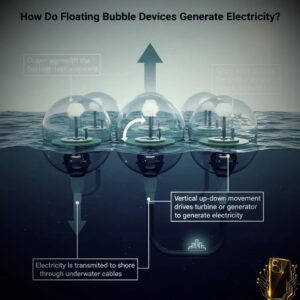
How Do Floating Bubble Devices Generate Electricity?
Ocean waves lift the floating device upward.
When wave passes, the device moves downward.
This vertical up down movement drives turbine or generator to generate electricity
At last, this Electricity is transmitted to shore through underwater cables
That’s process repeats continuously as long as waves lift the floating bubble upward and downward and create Continuous and renewable energy.
Hinged floating platforms:
Hinged floating platforms are an advanced method of generating electricity from ocean waves. It also works like a floating bubble, generating electricity as the waves of the ocean move up and down. These systems consist of multiple floating sections connected by hings, allowing them to bend and move freely as waves pass through them.
The mechanical motion as a result of wave motion created at the hinges is converted into electrical energy.
This technology is inspired and has been tested in several wave energy research projects.
Hinged Floating Platforms: These are long, segmented floating structures Which floats above the surface of the sea.
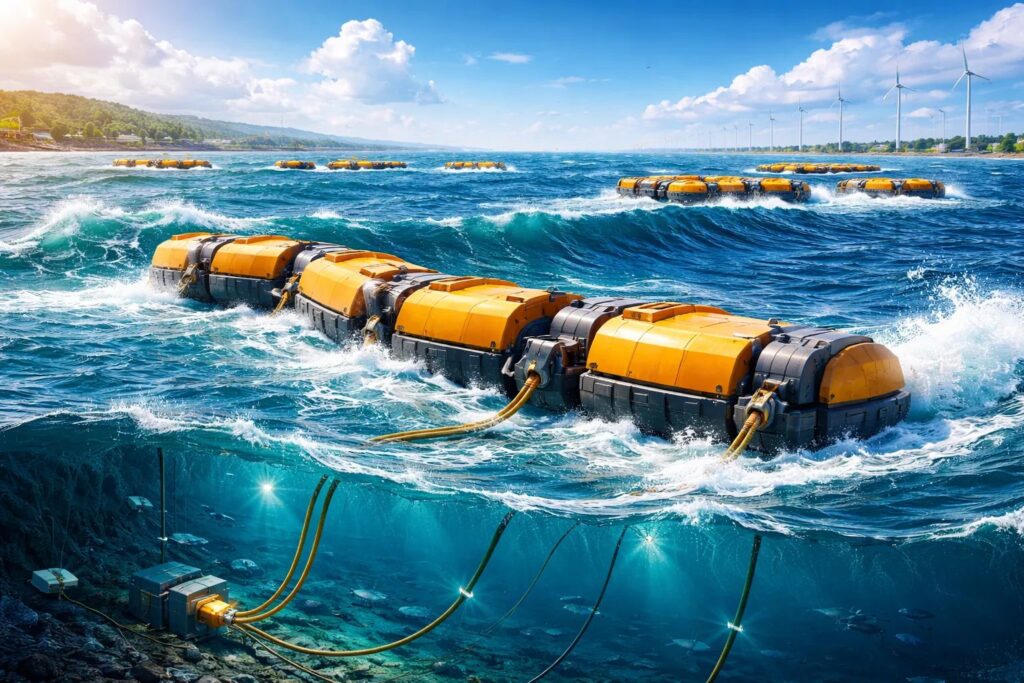
When waves move along the platform:
- The sections rise and fall
- Electrical energy is generated at the hinge points
These platforms are often adjusted parallel along the direction of the wave to create maximum energy.
Future Potential:
Although a single device does not produce huge energy but a group of devices can produce a meaningful amount of electricity.
This is the energy capability created by a single device:
100 kW – 750 kW (kilowatts)
However with advancements in materials science, Maybe in the future it will Supply electricity to coastal cities and Power offshore industries
Status:
While still under development, but There will be a lot of trending about in the future.
Tidal Energy (Underwater Turbines)
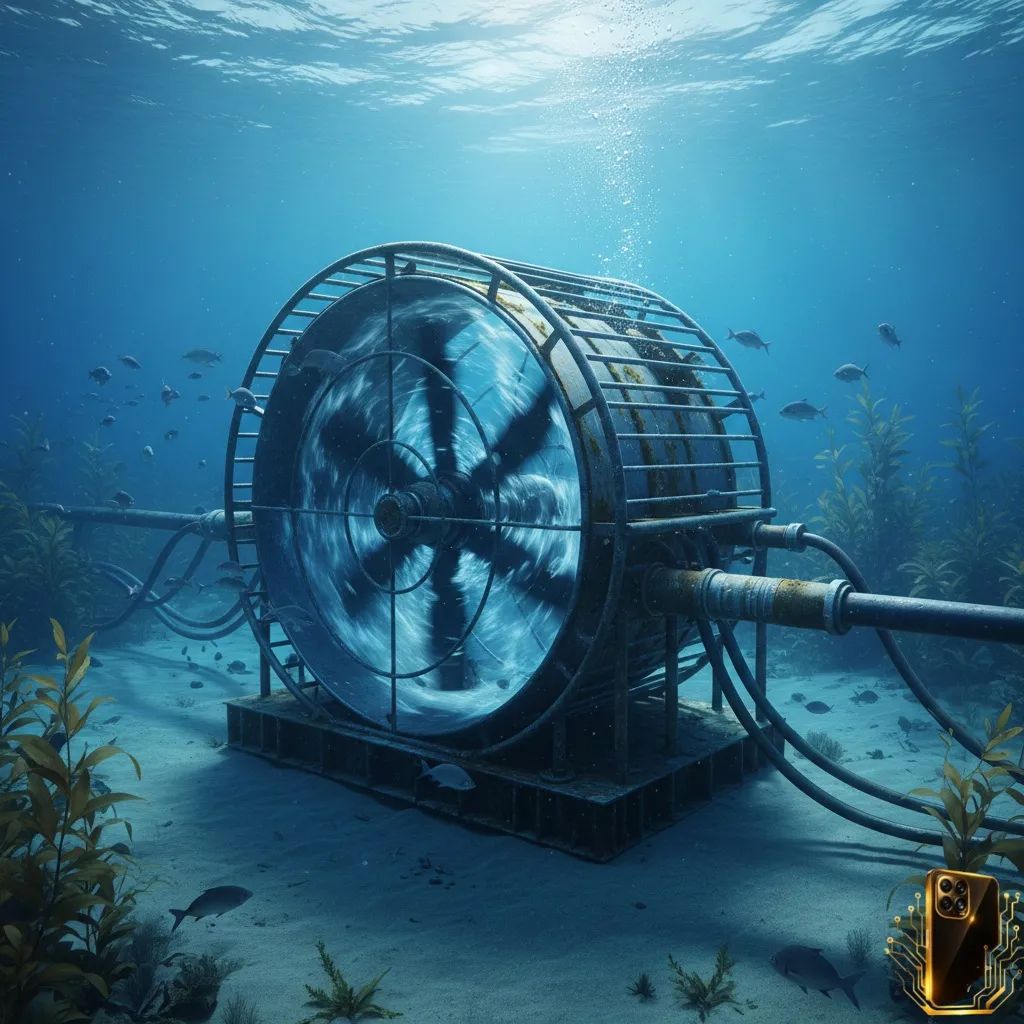
It also uses the natural movement of ocean tides to generate electricity through underwater turbines. But the only difference here is that in this process, the turbines are thrown into the sea.
How Tidal Energy work?
Basically, tidal energy is created when sea level rises or falls caused by the gravitational pull of the Moon and the Sun. This gravitational pull creates strong tidal currents in the ocean water.
Underwater turbines are placed in areas where tidal currents are strong like Narrow sea lanes and Coastal straits and near coastal areas.
Working Principle:
- When a strong current flows through the turbine, it spins turbine’s blades.
- This blade Rotation drives a generator inside the turbine
- Finally Mechanical energy is converted into electrical energy
- This generated electricity is then transmitted to shore using subsea cables.
Status:
This electricity generating design model is Similar to underwater wind turbines.That’s why it’s functional and it’s working right now in many regions of the world.
About the Author