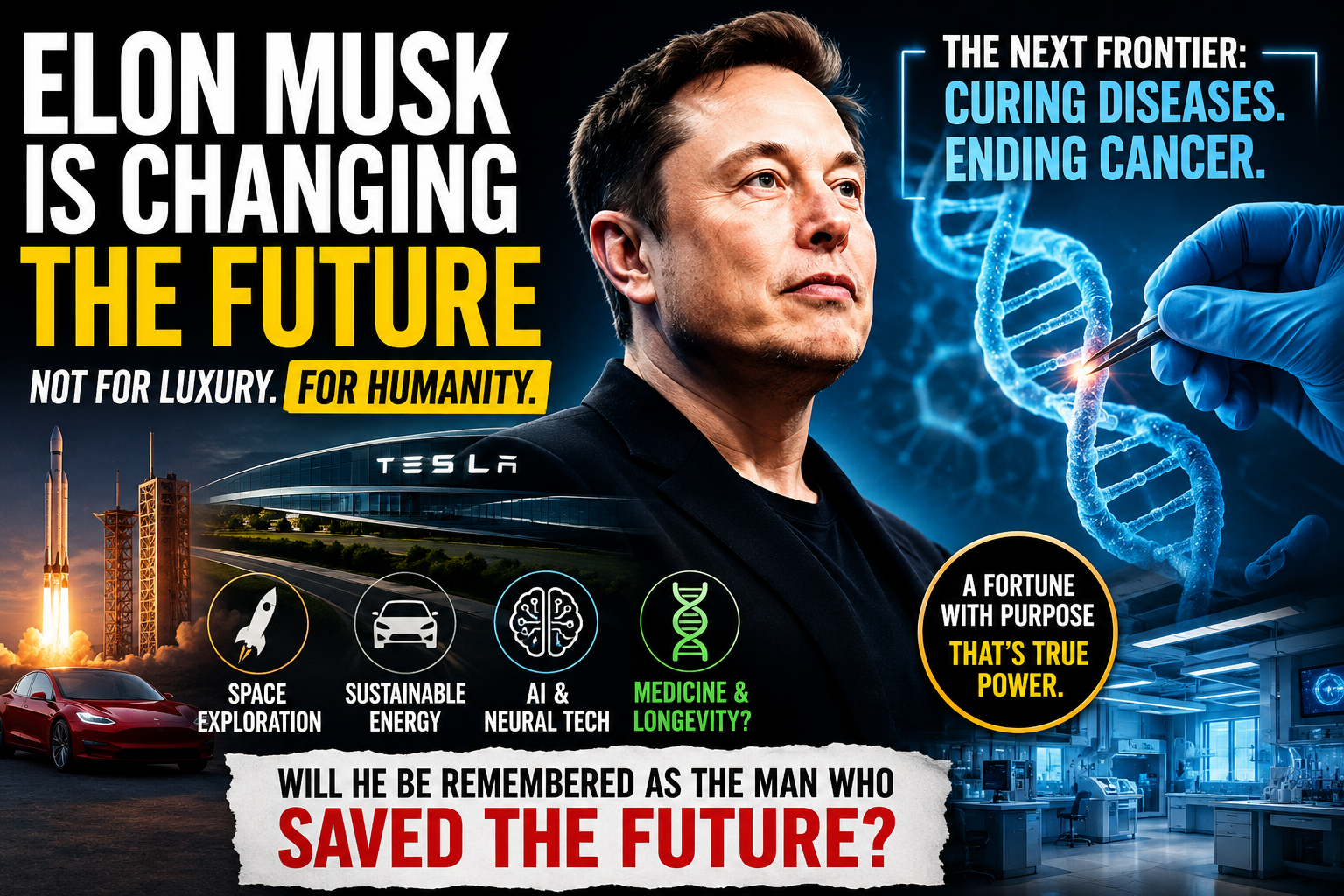
In an era defined by unprecedented technological acceleration, few figures spark as much fascination—and debate—as Elon Musk. Often described as one of the richest individuals in modern history, Musk represents more than just financial success. He embodies a new model of influence, where wealth is not merely accumulated, but actively deployed to reshape the future.
Despite viral claims on social media, Musk has not reached trillionaire status. His net worth fluctuates with Tesla’s stock and other ventures, typically placing him among the top global billionaires—not yet in the trillion-dollar category. Still, even at this level, his financial power is extraordinary, raising a more important question: What should one person do with such influence?p
Wealth as a Tool, Not a Trophy
Unlike many ultra-wealthy individuals known for extravagant lifestyles, Musk’s public persona is strikingly different. He does not center his identity around luxury. Instead, he channels most of his energy—and capital—into ambitious, high-risk ventures.
Through companies like SpaceX, Tesla, Neuralink, and xAI, Musk is tackling challenges that range from sustainable energy and interplanetary travel to brain-computer interfaces and artificial intelligence. These are not short-term profit plays; they are long-horizon bets on the future of humanity.
This approach reframes wealth as a tool for large-scale experimentation rather than a symbol of personal success.
This approach reframes wealth as a tool for large-scale experimentation rather than a symbol of personal success.
The Power—and Risk—of Concentrated Influence
However, there is a dual reality to this model. When immense resources are controlled by a single individual, the potential for progress is matched by the risk of imbalance. Musk can accelerate innovation at a pace governments often cannot—but he also operates with far fewer constraints.
This raises difficult questions:
- Who decides which problems deserve attention?
- What happens if those decisions are flawed?
- Should the future of critical technologies depend on individual vision rather than collective governance?
History suggests that transformative figures are rarely judged only by their intentions—but by the long-term consequences of their actions.
Could Medicine Be the Next Frontier?
The idea that Musk might pivot toward medicine—particularly gene editing and disease eradication—is intriguing, but currently speculative. While he has shown interest in health-related technology through Neuralink, his primary focus remains on neuroscience and human-computer integration, not direct disease cures.
That said, the logic behind the speculation isn’t unfounded. With advances in CRISPR gene editing, AI-driven drug discovery, and biotechnology, the next revolution in human progress may indeed come from medicine. If Musk—or any similarly resourced innovator—chooses to invest deeply in this space, the impact could be profound.
Yet breakthroughs in healthcare are fundamentally different from rockets or electric cars. They require:
- Long clinical testing cycles
- Strict regulatory oversight
- Deep collaboration with global scientific communities
Progress here is slower, but its implications are deeply personal—and universal.
Legacy Beyond Wealth
Ultimately, Musk’s legacy will not be defined by whether he becomes the world’s first trillionaire. That milestone, while historic, is symbolic. What will matter is what changes because he existed.
Did his efforts accelerate humanity’s transition to sustainable energy?
Did he make space exploration viable beyond Earth?
Did his technologies improve everyday human life—or introduce new risks?
These are the measures history tends to remember.
Final Thought
Elon Musk represents a rare convergence of capital, ambition, and technological vision. Whether one views him as a visionary or a controversial disruptor, his role in shaping the future is undeniable.
The real story is not how much wealth he accumulates—but how effectively he transforms it into something that outlasts him.
About the Author