
Introduction
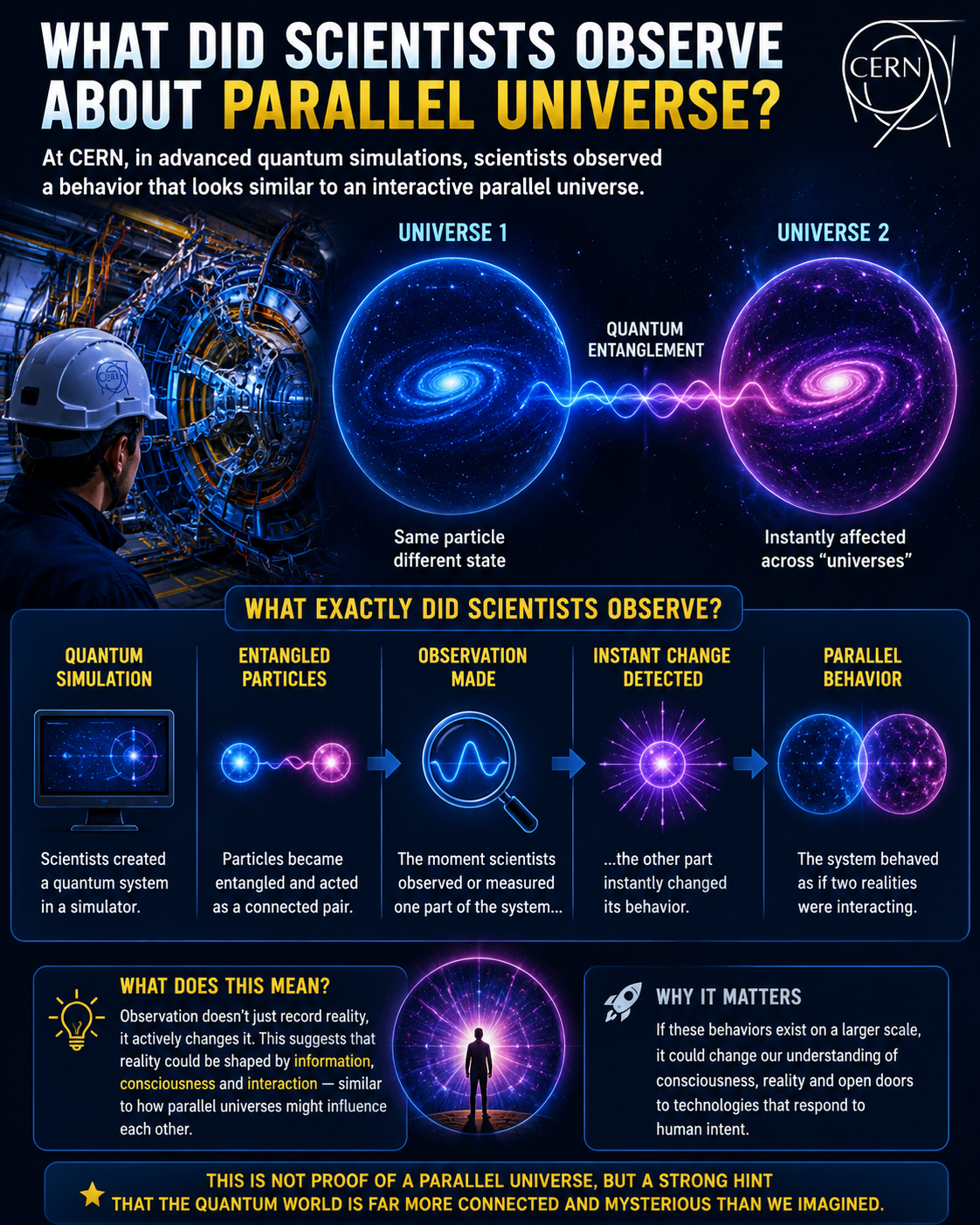
The concept of the multiverse has long been a tantalizing topic in both scientific and philosophical discussions. Recent advancements at CERN, the European Organization for Nuclear Research, have reignited debates around this enigmatic theory. While definitive proof of a multiverse remains elusive, scientific explorations at CERN may bring us closer to understanding this complex idea.
What is the Multiverse?
The multiverse theory posits that our universe is just one of countless others, each with its own distinct properties and laws of physics. This concept arises from various interpretations of quantum mechanics and cosmological models, suggesting that multiple, perhaps infinite, universes exist simultaneously. The multiverse is often categorized into different types:
- Level I Multiverse: Infinite space leads to regions with varying conditions.
- Level II Multiverse: Bubble universes formed from different vacuum states in cosmic inflation.
- Level III Multiverse: Parallel worlds resulting from quantum mechanics, where every decision spawns a new universe.
- Level IV Multiverse: All mathematical structures exist as their own physical realities.
CERN’s Role in Multiverse Research
CERN’s primary focus is particle physics. The Large Hadron Collider (LHC), the world’s largest and most powerful particle accelerator, plays a crucial role in exploring fundamental particles and the forces that govern them. The findings from the LHC have provided insights that may relate to multiverse theories:

- Higgs Boson Discovery: The Higgs boson, discovered at CERN in 2012, is vital for understanding the mass of particles. Its properties could hint at the existence of other universes with different Higgs fields.
- Cosmic Inflation: CERN scientists explore the rapid expansion of the universe after the Big Bang. Studies surrounding inflation theory suggest that different regions of space-time might evolve into separate bubble universes.
- Extra Dimensions: Certain theories posit that dimensions beyond our perception might influence the fundamental forces we observe, thus allowing for the existence of multiple universes.
Theoretical Implications
The existence of a multiverse challenges our understanding of reality. It raises questions about the fine-tuning of constants and laws in our universe. If other universes exist with different physical properties, this could explain why our universe seems so uniquely designed for life.
Philosophical Considerations
The multiverse also invites philosophical inquiries about existence and reality. If infinitely many outcomes exist, what does that mean for concepts like fate, choice, and individuality? The implications are profound and extend into discussions of determinism and free will.
Conclusion
While CERN scientists have not “discovered” the multiverse in a traditional sense, their research has opened new avenues for exploring this fascinating concept. Through the study of particle physics and the fundamental forces of nature, we may one day obtain a clearer understanding of whether a multiverse is merely a theoretical construct or a tangible reality. For now, the quest continues—pushing the boundaries of our knowledge and understanding of the cosmos.
Future Research Directions
As research at CERN progresses, future experiments may yield further insights into the nature of the universe, possibly providing evidence to support or refute multiverse theories. Continued collaboration between physicists, cosmologists, and philosophers will be essential to unravel the complexities of existence itself.
The journey to comprehend the multiverse is ongoing, and with each discovery, we inch closer to understanding the ultimate nature of reality.
About the Author